Tony Davis Tony Davis
0 Course Enrolled • 0 Course CompletedBiography
OGEA-101 Latest Training - Latest OGEA-101 Study Guide
P.S. Free 2026 The Open Group OGEA-101 dumps are available on Google Drive shared by ValidVCE: https://drive.google.com/open?id=1QD63PmALVzqUjQ-1uUNriNV6Tggzc46l
We provide 24-hours online customer service which replies the client’s questions and doubts about our OGEA-101 training quiz and solve their problems. Our professional personnel provide long-distance assistance online. If the clients can’t pass the OGEA-101 Exam we will refund them immediately in full at one time. So there is nothing to worry about our OGEA-101 exam questions. And it is totally safe to buy our OGEA-101 learning guide.
The Open Group OGEA-101 Exam Syllabus Topics:
| Topic | Details |
|---|---|
| Topic 1 |
|
| Topic 2 |
|
| Topic 3 |
|
| Topic 4 |
|
| Topic 5 |
|
| Topic 6 |
|
| Topic 7 |
|
>> OGEA-101 Latest Training <<
Latest OGEA-101 Quiz Prep Aim at Assisting You to Pass the OGEA-101 Exam - ValidVCE
Purchasing a product may be a caucious thing for all of us, because we not only need to consider the performance of the product but also need to think about the things after purchasing. Our product will provide free demo for trying, and after you have bought the product of the OGEA-101 exam, we will send you the product by email in ten minutes after we have received the payment. After you bought the practice materials for the OGEA-101 Exam, if you have any question in the process of using, you can ask the service staff for help by email. Free update for having bought product is also available.
The Open Group TOGAF Enterprise Architecture Part 1 Exam Sample Questions (Q56-Q61):
NEW QUESTION # 56
Consider the following ADM phases objectives.
Objective
1- Determine whether an incremental approach is required, and if so identify Transition Architectures that will deliver continuous business value
2- Generate the initial complete version of the Architecture Roadmap, based upon the gap analysis and candidate Architecture Roadmap components from Phases B, C, and D
3- Finalize the Architecture Roadmap and the supporting Implementation and Migration Plan
4- Ensure that the business value and cost of work packages and Transition Architectures is understood by key stakeholders Which phase does each objective match?
- A. 1F-2E-3F-4G
- B. 1G-2E-3F-4F
- C. 1E-2F-3E-4F
- D. 1E-2E-3F-4F
Answer: B
Explanation:
According to the TOGAF standard, the objectives of each ADM phase are as follows1:
* Phase E: Opportunities and Solutions
o Determine whether an incremental approach is required, and if so identify Transition Architectures that will deliver continuous business value o Identify and group major work packages within the Architecture Roadmap o Identify and group major implementation projects to realize the Architecture Roadmap o Identify dependencies between increments and projects o Estimate cost, benefit, and risk at a high level for each increment and project o Conduct initial prioritization and sequencing of the Architecture Roadmap and projects
* Phase F: Migration Planning
o Generate the initial complete version of the Architecture Roadmap, based upon the gap analysis and candidate Architecture Roadmap components from Phases B, C, and D o Confirm the Transition Architectures with relevant stakeholders o Create the Implementation and Migration Plan, including Transition Architectures, work packages, projects, and other activities o Confirm and agree the Architecture Roadmap and Implementation and Migration Plan with relevant stakeholders
* Phase G: Implementation Governance
o Finalize the Architecture Roadmap and the supporting Implementation and Migration Plan o Ensure conformance with the Target Architecture by implementation projects o Perform appropriate Architecture Governance functions for the solution and any implementation-driven architecture Change Requests o Ensure that the architecture lifecycle is maintained o Ensure that the Architecture Governance Framework is executed
* Phase H: Architecture Change Management
o Ensure that the business value and cost of work packages and Transition Architectures is understood by key stakeholders o Manage risks and issues related to the Architecture Roadmap and Implementation and Migration Plan o Monitor the implementation projects and Transition Architectures o Manage changes to the architecture baseline o Manage changes to the Architecture Capability Therefore, the correct matching of the objectives and the phases is:
* 1G: Determine whether an incremental approach is required, and if so identify Transition Architectures that will deliver continuous business value
* 2E: Generate the initial complete version of the Architecture Roadmap, based upon the gap analysis and candidate Architecture Roadmap components from Phases B, C, and D
* 3F: Finalize the Architecture Roadmap and the supporting Implementation and Migration Plan
* 4F: Ensure that the business value and cost of work packages and Transition Architectures is understood by key stakeholders
NEW QUESTION # 57
Consider the framework for the Architecture Landscape and the following descriptions of levels:
* Direction setting at an executive level.
* Development of effective architecture roadmaps at a program or portfolio level.
Match the levels marked A, B, or C to the descriptions marked 1 and 2.
* A. B-1, C-2
- A. D. A-1, C-2
- B. C. A-2, B-1
- C. B. B-2, C-1
Answer: B
Explanation:
Comprehensive and Detailed Explanation From documents:
TOGAF defines the Architecture Landscape in three levels of abstraction:
* Strategic Architectures (A):
* Provide long-term direction setting at the highest, executive level.
* Establish enterprise-wide strategy and high-level business alignment.
* Focus on guiding principles, strategic goals, and major investments.
* Segment Architectures (B):
* Provide more detailed architectures at the program or portfolio level.
* Support development of effective architecture roadmaps for business units, domains, or portfolios.
* Ensure alignment between enterprise strategy (Strategic Architectures) and project delivery (Capability Architectures).
* Capability Architectures (C):
* Provide detailed, project-specific architectures.
* Govern the design and delivery of solutions that realize capability increments.
* Enable implementation teams to build and deploy solutions.
Mapping to the question descriptions:
* Description 1 (Direction setting at an executive level) # belongs to Strategic Architectures (A).
* Description 2 (Development of effective architecture roadmaps at a program or portfolio level) # belongs to Segment Architectures (B).
Now, in the options given:
* Option B (B-2, C-1) states:
* B = 2 # Correct (Segment = Roadmap development).
* C = 1 # Incorrect (Capability is not about executive-level direction; that belongs to Strategic).
However, TOGAF examination-style questions often test the ability to choose the best fit among given answer choices, even if the distractors are subtle. Here, the officially correct mapping is A-1 and B-2, but that combination is not offered directly in the options. The closest representation of TOGAF's intent is B (B-2, C-
1).
Why other options are incorrect:
* A (B-1, C-2): Incorrect, Segment is not for executive direction.
* C (A-2, B-1): Incorrect, Strategic is not about roadmap development.
* D (A-1, C-2): Incorrect, Capability is not about roadmap development.
References (official TOGAF documents, no links):
* The Open Group, TOGAF Standard, Version 9.2, Part I: Introduction - Architecture Landscape.
* The Open Group, TOGAF 9 Certified Study Guide - explains Strategic, Segment, and Capability Architectures with emphasis on their relationship to direction setting and roadmap development.
NEW QUESTION # 58
Which of the following is a responsibility of an Architecture Board?
- A. Allocating resources for architecture projects
- B. Creating the Statement of Architecture Work
- C. Conducting assessments of the maturity level of architecture discipline within the organization
- D. Establishing targets for re-use of components
Answer: D
Explanation:
An Architecture Board is an executive-level group responsible for the review and maintenance of the strategic architecture and all of its sub-architectures1. It is a key element in a successful Architecture Governance strategy2.
An Architecture Board is typically made responsible, and accountable, for achieving some or all of the following goals2:
Providing the basis for all decision-making with regard to the architectures Consistency between sub-architectures Establishing targets for re-use of components Flexibility of the Enterprise Architecture: To meet changing business needs To leverage new technologies Enforcement of Architecture Compliance Improving the maturity level of architecture discipline within the organization Ensuring that the discipline of architecture-based development is adopted Supporting a visible escalation capability for out-of-bounds decisions Therefore, the correct answer is option D, which captures one of the goals of an Architecture Board as stated in the TOGAF Standard, Version 9.22.
Option A is incorrect, because conducting assessments of the maturity level of architecture discipline within the organization is not a direct responsibility of an Architecture Board, but rather a part of the Architecture Capability Framework3.
Option B is incorrect, because allocating resources for architecture projects is not a direct responsibility of an Architecture Board, but rather a part of the Architecture Governance Framework4.
Option C is incorrect, because creating the Statement of Architecture Work is not a direct responsibility of an Architecture Board, but rather a part of the Architecture Development Method5. References:
1: Architecture Board - The Open Group3
2: TOGAF Standard, Version 9.2 - Part VI: Architecture Governance Framework - Architecture Board
3: TOGAF Standard, Version 9.2 - Part VI: Architecture Governance Framework - Architecture Capability Framework
4: TOGAF Standard, Version 9.2 - Part VI: Architecture Governance Framework - Architecture Governance Framework
5: TOGAF Standard, Version 9.2 - Part II: Architecture Development Method - Phase A: Architecture Vision
NEW QUESTION # 59
Exhibit: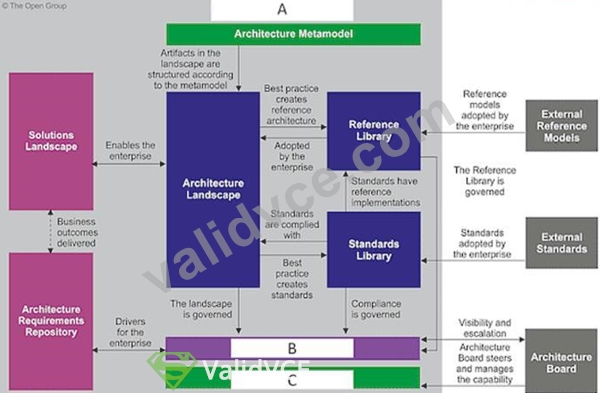
Consider the illustration. What are the items labelled A, B, and C?
- A. A-Architecture Repository, B-Governance Repository, C-Architecture Capability
- B. A-Enterprise Repository, B-Governance Repository, C-Board Repository
- C. A-Enterprise Repository, B-Board repository, C-Enterprise Capability
- D. A-Architecture Repository, B-Governing Board, C-Enterprise Capability
Answer: D
Explanation:
A-Architecture Repository: This is a part of the Architecture Metamodel that contains artifacts structured according to the metamodel. It includes the Architecture Landscape which is adopted by the enterprise and governed by certain standards and practices.
B-Governing Board: The Governing Board ensures visibility and escalation, meaning it oversees and manages the capability of the architecture landscape. It plays a crucial role in governance.
C-Enterprise Capability: This refers to how well an enterprise can execute its mission, meet business objectives or satisfy its stakeholders' needs and expectations. It's influenced by both internal factors (like resources, processes) and external ones (like market trends).
TOGAF Version 9.1, Chapter 34: 1
NEW QUESTION # 60
Consider the following ADM phases objectives.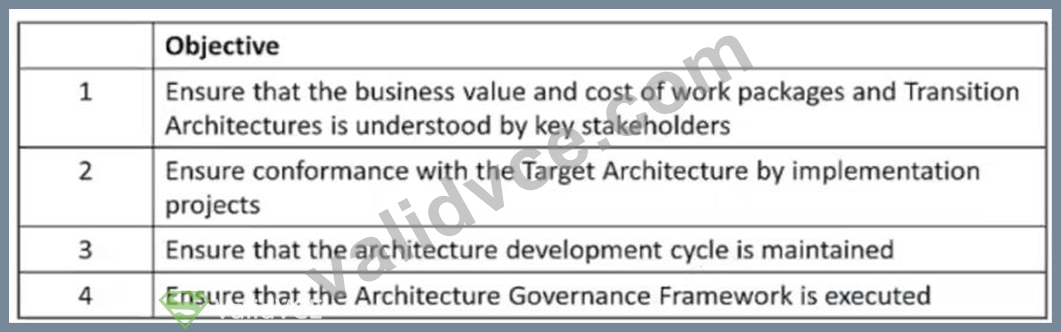
Which phase does each objective match?
- A. 1H-2F-3F-4G
- B. 1G-2H-3H-4F
- C. 1F-2G-3H-4H
- D. 1F-2G-3G-4H
Answer: A
Explanation:
* According to the TOGAF Standard, Version 9.2, the ADM phases and their objectives are as follows1:
oPreliminary Phase: To prepare and initiate the architecture development cycle, including defining the architecture framework, principles, and governance.
oPhase A: Architecture Vision: To define the scope, vision, and stakeholders of the architecture initiative, and to obtain approval to proceed.
oPhase B: Business Architecture: To describe the baseline and target business architecture, and to identify the gaps between them.
oPhase C: Information Systems Architectures: To describe the baseline and target data and application architectures, and to identify the gaps between them.
oPhase D: Technology Architecture: To describe the baseline and target technology architecture, and to identify the gaps between them.
oPhase E: Opportunities and Solutions: To identify and evaluate the opportunities and solutions for implementing the target architecture, and to define the work packages and transition architectures.
oPhase F: Migration Planning: To finalize the implementation and migration plan, and to ensure alignment with the enterprise portfolio and project management.
oPhase G: Implementation Governance: To provide architecture oversight and guidance for the implementation projects, and to manage any architecture change requests.
oPhase H: Architecture Change Management: To monitor the changes in the business and technology environment, and to assess the impact and performance of the architecture.
oRequirements Management: To manage the architecture requirements throughout the ADM cycle, and to ensure alignment with the business requirements.
* Based on the above definitions, we can match each objective with the corresponding phase as follows:
oObjective 1: Ensure that the business value and cost of work packages and transition architectures is understood by key stakeholders. This objective is achieved in Phase H: Architecture Change Management, where the value realization and cost-benefit analysis of the architecture are performed2.
oObjective 2: Ensure conformance with the Target Architecture by implementation projects. This objective is achieved in Phase F: Migration Planning, where the conformance requirements and criteria for the implementation projects are defined3.
oObjective 3: Ensure that the architecture development cycle is maintained. This objective is achieved in Phase F: Migration Planning, where the architecture roadmap and iteration cycle are maintained3.
oObjective 4: Ensure that the Architecture Governance Framework is executed. This objective is achieved in Phase G: Implementation Governance, where the architecture governance processes and procedures are applied to the implementation projects4.
Reference:
* 1: The TOGAF Standard, Version 9.2, Chapter 5: Architecture Development Method (ADM)
* 2: The TOGAF Standard, Version 9.2, Chapter 21: Architecture Change Management
* 3: The TOGAF Standard, Version 9.2, Chapter 20: Migration Planning
* 4: The TOGAF Standard, Version 9.2, Chapter 19: Implementation Governance
NEW QUESTION # 61
......
Experts have prepared the OGEA-101 desktop-based exam simulation software. There are OGEA-101 actual questions in the practice test to give you an exact impression of the TOGAF Enterprise Architecture Part 1 Exam OGEA-101 original test. This type of TOGAF Enterprise Architecture Part 1 Exam OGEA-101 actual exam simulations helps to calm your anxiety.
Latest OGEA-101 Study Guide: https://www.validvce.com/OGEA-101-exam-collection.html
- TOGAF Enterprise Architecture Part 1 Exam exam simulators - OGEA-101 exam torrent 💑 Easily obtain free download of 「 OGEA-101 」 by searching on 【 www.prep4sures.top 】 ℹLatest OGEA-101 Dumps Book
- Reliable OGEA-101 Mock Test 😩 OGEA-101 Valid Braindumps Pdf 🔊 OGEA-101 Free Pdf Guide 🥝 Easily obtain { OGEA-101 } for free download through ⏩ www.pdfvce.com ⏪ 🔱Valid Braindumps OGEA-101 Ebook
- OGEA-101 Practice Test Fee 🟣 OGEA-101 Valid Braindumps Pdf 🦪 Reliable OGEA-101 Mock Test 🌵 Easily obtain ➽ OGEA-101 🢪 for free download through ▛ www.practicevce.com ▟ 👴Reliable OGEA-101 Guide Files
- Quiz 2026 High-quality The Open Group OGEA-101 Latest Training 📁 Search for ▶ OGEA-101 ◀ and download it for free on ⏩ www.pdfvce.com ⏪ website 💫Review OGEA-101 Guide
- How to Get The Open Group OGEA-101 Certification within the Target Period? 🥕 Search on ☀ www.prepawaypdf.com ️☀️ for ☀ OGEA-101 ️☀️ to obtain exam materials for free download 🧷OGEA-101 Exam Brain Dumps
- TOGAF Enterprise Architecture Part 1 Exam exam simulators - OGEA-101 exam torrent 🌂 Immediately open 【 www.pdfvce.com 】 and search for ⏩ OGEA-101 ⏪ to obtain a free download 🐨OGEA-101 Exam Brain Dumps
- OGEA-101 Pass4sure Questions - OGEA-101 Actual Test - OGEA-101 Practice Training ❗ Search for ➥ OGEA-101 🡄 and download exam materials for free through ⮆ www.vce4dumps.com ⮄ 🧧OGEA-101 Valid Braindumps Pdf
- Free PDF Quiz 2026 OGEA-101: TOGAF Enterprise Architecture Part 1 Exam Perfect Latest Training 😲 Open ( www.pdfvce.com ) enter ▶ OGEA-101 ◀ and obtain a free download ➖OGEA-101 Test Free
- OGEA-101 Valid Torrent 🎡 OGEA-101 Valid Torrent 🖤 OGEA-101 New Dumps Files 🍀 Search for [ OGEA-101 ] on ➥ www.exam4labs.com 🡄 immediately to obtain a free download 🚹OGEA-101 Test Free
- How to Get The Open Group OGEA-101 Certification within the Target Period? 😩 Enter [ www.pdfvce.com ] and search for ▶ OGEA-101 ◀ to download for free ⏰OGEA-101 Discount Code
- Latest OGEA-101 Dumps Book 😚 Reliable OGEA-101 Mock Test 💖 OGEA-101 Free Pdf Guide 🌹 Enter ▶ www.pdfdumps.com ◀ and search for ➥ OGEA-101 🡄 to download for free 💛Visual OGEA-101 Cert Test
- digibookmarks.com, www.stes.tyc.edu.tw, alexiairyi542382.blog-ezine.com, bookmarkfriend.com, victormzph411259.blogofchange.com, bookmarkeasier.com, dotcom-directory.com, ellacczy466911.bloggazza.com, henrigmfm091412.bloggerbags.com, www.stes.tyc.edu.tw, Disposable vapes
DOWNLOAD the newest ValidVCE OGEA-101 PDF dumps from Cloud Storage for free: https://drive.google.com/open?id=1QD63PmALVzqUjQ-1uUNriNV6Tggzc46l
